Before the Engineers Arrive: What to Prepare for a Core Cutting Line Installation
Most installation delays are decided before the engineers arrive. This is the preparation list from our technical specifications for cut-to-length and slitting lines, with the reasons behind each item and four more points we recommend agreeing in writing.
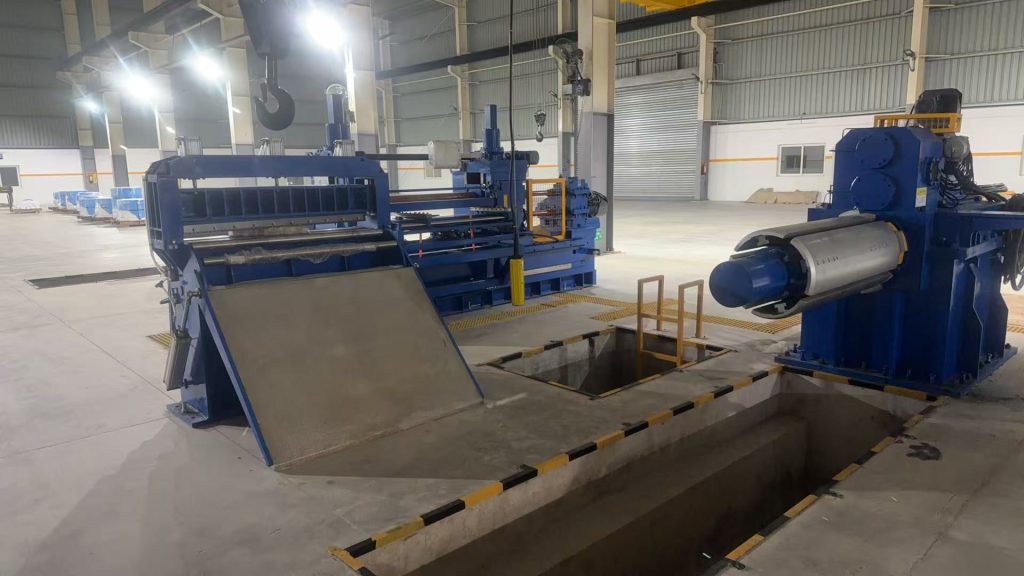
When a cut-to-length or slitting line takes longer to commission than planned, the cause is rarely the machine. It is usually something on site: a foundation that does not match the drawing, a power supply that is not yet connected, compressed air that is wet, or no coil of the right width for the acceptance test. All of these are decided weeks before the installation team lands, which is why every SREE technical specification includes a short section on what the customer prepares before installation and commissioning.
This article sets out that list, explains why each item is there, and adds four points that are not in the specification but that we recommend agreeing in writing before the line is shipped.
The six items in the technical specification
These six items appear in the technical specifications for our cut-to-length lines and, with small differences, our slitting lines. They are part of the documents the customer signs, so they are not extra requests; they are the conditions the installation plan assumes.
- Foundation built to the foundation drawing. The drawing is sent with the contract documents. Pits, anchor positions and floor level all follow it, and the line centreline is set out from it. A foundation that is a few centimetres out can usually be corrected on site, but a pit in the wrong place cannot.
- Power supply brought to the incoming terminals of the control cabinet. The supply type and capacity are stated in the specification for each line, and they differ between machine types: in our files cut-to-length lines are specified for three-phase four-wire and slitting lines for three-phase five-wire. The cable to the cabinet is the customer’s scope; everything after the incoming terminals is ours.
- Stacking trolleys and pallets. We supply a reference drawing for the lamination trolley; the plant builds or buys trolleys and pallets that fit its own crane, floor and assembly area. On a cut-to-length line this is where the finished laminations go, so the line cannot be tested under load without them.
- Steel plates for installation. For a cut-to-length line the specification lists about 50 steel plates of 100 × 300 × 15 mm, used under the machine bases for levelling and anchoring.
- Coils for the final acceptance test. The acceptance test is run on the customer’s own material, so coils of the contract width and grade, and the lamination shapes named in the contract, need to be in the plant when commissioning starts.
- Compressed air to specification. Dry air with a dew point of −40 °C, oil content of 1 mL/m³ and particles no larger than 1 μm, with fewer than 20 particles of 0.5–1 μm per litre. From a central supply the pressure at the machine should be at least 0.6 MPa, and we suggest a 2 m³ receiver close to the line. If a dedicated compressor is used, it should deliver 1.5 m³/min at 0.8 MPa.
Four more points worth agreeing in writing
The following are not in the standard specification, but on installations at home and abroad they are the questions that most often come up on the first day. Settling them before shipment saves that day.
- Access and lifting. Confirm the route into the building, the crane or forklift capacity at the installation position, and which party provides lifting during unloading and erection.
- Spare parts and accessories list. Both sides sign the list of accessories and spare parts before the container is loaded, so that nothing has to be sent separately after arrival.
- Named people for training. The plant names at least one operator and one maintenance technician who will attend commissioning and training. Operators who run the line themselves while our engineers are still on site are far more confident afterwards, including when adjusting parameters.
- Factory test record. Every line cuts a quantity of laminations in our works and is inspected before it is released for shipment. Ask for that test record to travel with the machine, so that the site test can be compared with it.
A simple timeline
For a line going abroad, a workable sequence is: foundation drawing and utility data sent with the contract documents; foundation poured and cured while the line is being built; power, air and handling ready before shipment; coils for the acceptance test in the plant before the team arrives. On our recent slitting line installation in India the line was standing on its foundation four days after the team landed, because the site work had been done in advance.
For the machines themselves, see the standard and high-speed cut-to-length lines and the slitting line. For the layout around them, see planning a transformer core shop layout.
Frequently asked questions
Who builds the foundation?
The customer builds it to SREE’s foundation drawing. Our engineers check it against the drawing before erection starts.
Can the line be commissioned without the customer’s coils?
No-load commissioning can, but the load test and final acceptance are run on the customer’s own coils of the contract width and grade, so those coils need to be available on site.
What compressed air quality does a cut-to-length line need?
Dry air with a dew point of −40 °C, oil content of 1 mL/m³ and filtration to 1 μm, at no less than 0.6 MPa at the machine from a central supply, or a dedicated compressor of 1.5 m³/min at 0.8 MPa.
Where is the exact power requirement stated?
In the technical specification of each line. It depends on the machine type and configuration, so it is confirmed per project rather than taken from a general figure.
Sizing a line for your core shop?
Send strip widths, thickness and monthly tonnage. You get a line proposal with knife layout and floor plan, or use the online selector to narrow the series first.