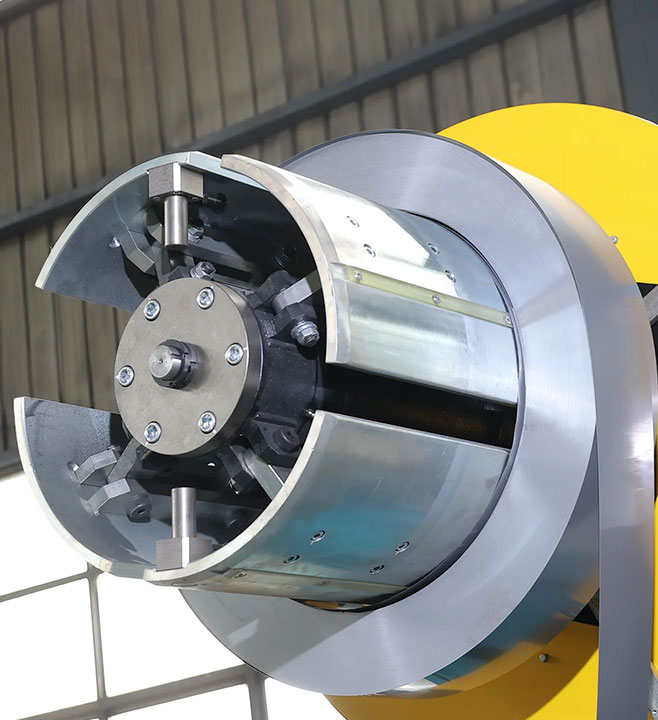
Cut-and-Stack Lines: When Combining Cutting and Stacking in One Machine Makes Sense
A cut-and-stack line cuts the laminations and builds the core in the same machine, so the pieces are never handled. Here is what that gains, what it costs in flexibility, and how it compares with a cutting line feeding a separate stacking line.
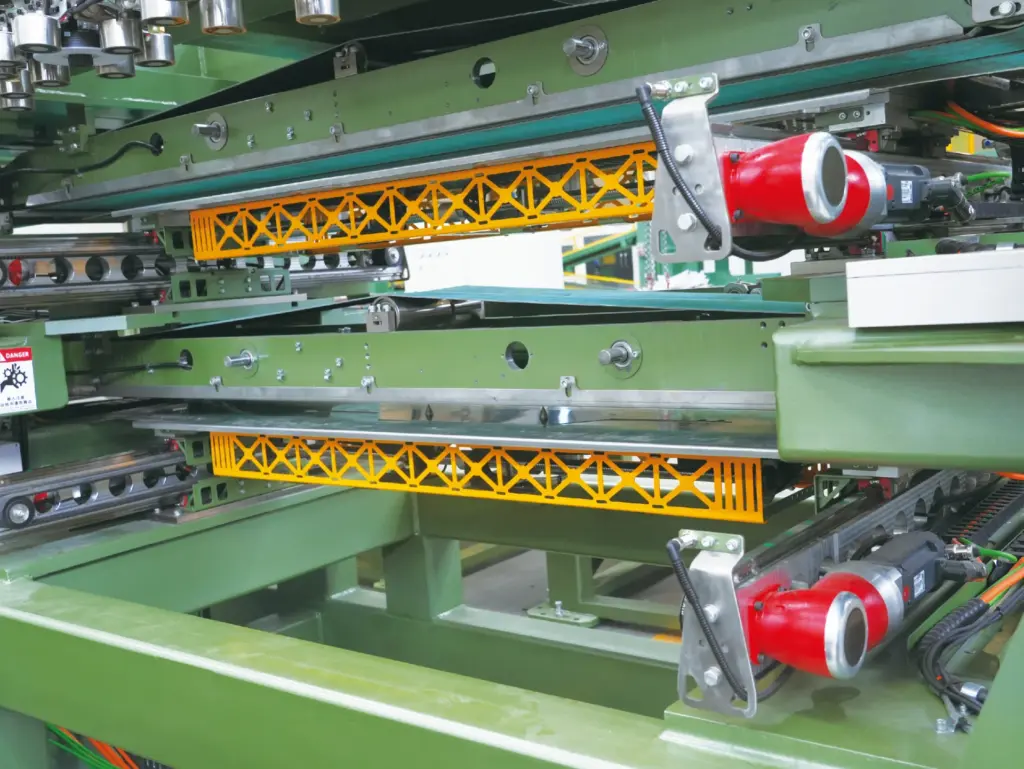
In a conventional core shop the cut-to-length line and the stacking operation are separate: laminations come off the line onto tables, wait in a buffer, and are built into cores somewhere else, by hand or by machine. A cut-and-stack combined line removes that gap. The shear drops each lamination onto a transfer, and robots place it straight into the core being built. The piece is never stacked on a table, never moved by forklift, never re-sorted. For the core sizes it covers, it is the shortest route from strip to core there is.
How the combined line works
The cutting half of an SRJD line is a high-speed cut-to-length line: decoiler, servo feed, a V-notch station, and a mitre shear, running continuously. The stacking half is a pair of robots with lamination grippers and a stacking station. As each piece is cut, it is conveyed to the pick position, a robot picks it and places it on the core in the programmed position, and the next piece follows. Two robots work in parallel, and the line builds two cores at once so that neither robot waits for the shear.
Because the stacking sequence is part of the cutting programme, the line cuts pieces in build order rather than in shape order. Limb, yoke, limb, yoke, with the step-lap length variations in sequence: exactly what the core needs next is what the shear cuts next. This is also why the combined line only needs one V-notch station; the in-line sequence never requires two notch geometries in the same pass.
What it gains
- No lamination handling. The single largest source of bent and scratched laminations in a core shop, handling between line and stacking table, is gone.
- No lamination buffer. Cut stacks do not wait for assembly, so the floor space and the work-in-progress that a buffer represents are not needed.
- Fewer people per core. Manual stacking is the most labour-intensive step in core production; the combined line replaces it for every core within its range.
- Consistent stacking. Robot placement is repeatable in a way that hand stacking, especially across shifts, is not; joint gaps and stack alignment come out the same on every core.
What it costs
- Coupled output. The cutting half can only run as fast as the stacking half can place pieces. The line’s output is a stacking rate, not a cutting rate.
- A size range. The robots, grippers and stacking station are built for a range of lamination widths and lengths. Cores outside that range, in particular large power transformer cores, need a separate cutting line and a larger stacking machine.
- One core type at a time. Since the line builds cores, not stacks, it works through its programme core by core. A plant that cuts stacks in advance for several core types has to plan differently.
SRJD400-224G in numbers
| Parameter | Value |
|---|---|
| سمك الشريط | 0.18 to 0.30 mm |
| عرض الشريط | 60 to 440 mm |
| طول الصفيحة | 400 to 1,800 mm |
| Feed speed | 210 m/min |
| تفاوت الطول | ±0.15 mm per 1,200 mm |
| Burr height | less than 0.02 mm |
| Stacking | Two robots, two cores built in parallel; three-limb and E+I core designs |
| Installed power | about 95 kW |
The full specification and videos of the line in production are on the cut-and-stack combined line page.
The alternative: cutting line plus stacking line
For cores beyond the combined line’s range, or for plants that want cutting and stacking decoupled, the conventional arrangement is a cut-to-length line feeding a separate خط التكديس through a buffer. Our SRDZ stacking lines cover this: the SRDZ1500 handles laminations from 50 to 300 mm wide and 600 to 1,500 mm long at around 30,000 sheets per eight-hour shift, and the SRDZ2200 handles laminations up to 2,200 mm long at 4,000 to 6,000 sheets per hour with joint gaps held to 0.3 mm or less.
The decoupled arrangement keeps the cutting line running at its own rate, lets one cutting line feed more than one stacking station, and covers larger cores. It needs the buffer and the handling that the combined line avoids, which in an automated shop means a stacker crane and storage; see planning a core shop layout.
Which to choose
| Choose a cut-and-stack combined line when | Choose cutting line plus stacking line when |
|---|---|
| Your cores are distribution-transformer size, within about 440 mm strip width and 1.8 m lamination length | You build larger cores, or a wide range from small to large |
| Handling damage and stacking labour are your main costs | Cutting output must not be limited by stacking rate |
| You want the smallest footprint per core produced | One cutting line should feed several stacking positions |
| Core types run in reasonable batches | You cut stacks ahead for many core types |
Frequently asked questions
Does the combined line stack step-lap cores?
Yes. The step-lap lengths and the stacking sequence are part of the programme, and the robots place each piece at its programmed position.
What happens if a robot stops?
The line stops with it; cutting and stacking are one process. This is the coupling described above, and it is the reason the line is specified with two robots working in parallel.
Can the combined line cut without stacking?
It is designed as one process, cutting into the core. If you regularly need loose lamination stacks as well, a separate cutting line is the better tool, and many plants run one beside the combined line.
Sizing a line for your core shop?
Send strip widths, thickness and monthly tonnage. You get a line proposal with knife layout and floor plan, or use the online selector to narrow the series first.