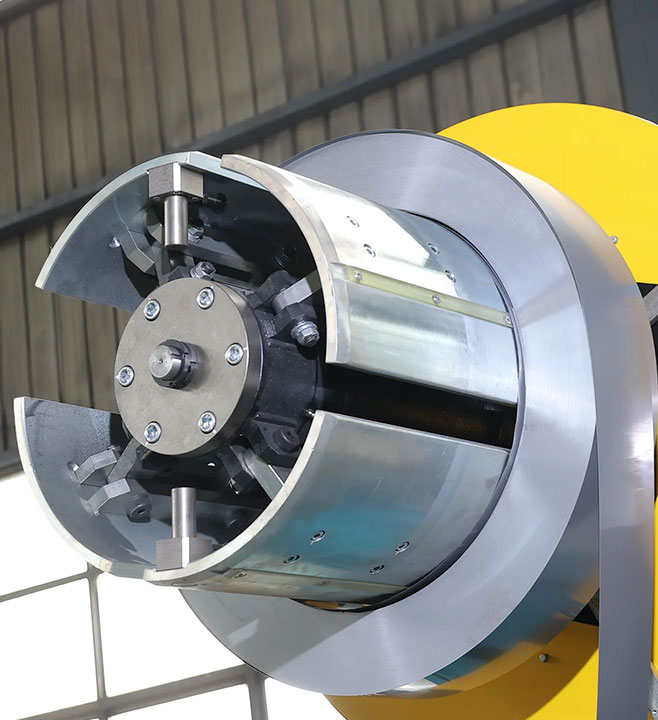
Transformer Core Cutting Lines: Slitting, Cut-to-Length and Stacking Machines
Everything that cuts, notches and stacks grain-oriented silicon steel into a transformer core, in one place: what each machine does, which one you need for your cores, the specifications that matter, and how SREE builds and delivers them.

“Transformer core cutting line” covers three different machines, and a core shop may need one, two or all of them. A slitting line cuts the master coil into strips. A cut-to-length line cuts the strips into laminations with mitred ends, V-notches and, where needed, bolt holes. A stacking machine, or a combined cut-and-stack line, builds those laminations into the core. SREE (Nantong Sirui Engineering Co., Ltd.) designs and builds all three, plus the storage and handling that connects them, and has delivered around 300 electrical steel machines to more than 100 core manufacturers.
The machines
| Machine | What it does | SREE series | Key figures |
|---|---|---|---|
| Silicon steel slitting line | Cuts a master coil lengthwise into strips of the widths the core needs | SRZJ | 11 knife pairs, up to 10 strips per pass, strips from 40 mm, up to 120 m/min, width ±0.1 mm |
| Standard cut-to-length line | Cuts strip into laminations, step feed; the workhorse for stable batch production | SRHJ …B | Classes 200 to 1000, 0.18–0.35 mm, up to 210 m/min rated, angle ±0.02°, length ±0.2 mm/2 m, burr ≤0.02 mm |
| High-speed cut-to-length line | Same laminations, continuous feed with flying stations; for high tonnage and frequent changeovers | SRHJ …G | Classes 200 to 600, 240 m/min peak, 210 rated, 120–180 working; all stations on servo axes |
| Linha combinada de corte e empilhamento | Cuts and robot-stacks the core in one machine; no lamination handling | SRJD | Up to 440 mm strip, 400–1,800 mm laminations, 210 m/min, two robots building two cores at once |
| Core stacking line | Builds cores from cut laminations delivered from a cutting line | SRDZ | SRDZ1500 about 30,000 sheets per 8 h; SRDZ2200 4,000–6,000 sheets/h, laminations to 2,200 mm, joint gap ≤0.3 mm |
| Core shop logistics and storage | Strip racks, shuttles, buffers, stacker cranes, tilting stations and AGVs that link the machines | SRWL / SRLK | Reference shop: 424-position strip store, 7-level buffer, 90-position core store, ±5 mm positioning |
Which line do you need?
Start from three facts about your production: the widest lamination you build, the tonnes of silicon steel you cut per month, and how the core is stacked today. The table gives the usual answer; the online line selector asks the same questions and returns a first configuration in about five minutes.
| Your situation | Usual answer | Read more |
|---|---|---|
| Starting a core shop, buying pre-slit strip | One standard cut-to-length line in the class that covers your widest lamination | Choosing the width class |
| More than about 300 t/month, or 100–300 t on two shifts | High-speed cut-to-length line | Standard vs high-speed |
| Buying master coils, or many strip widths | Add a slitting line and a strip store | Slitting vs cut-to-length |
| Distribution-size cores, stacking labour and handling damage are the main costs | Linha combinada de corte e empilhamento | When a combined line makes sense |
| Larger cores, or one cutting line feeding several stacking positions | Cutting line plus separate stacking line and buffer | Planning the shop layout |
| Moving to 0.20 or 0.18 mm steel | Check feed, burr control and stacking capacity; often the moment to go high-speed | Processing thin CRGO |
Specifications that matter
Whatever the supplier, a cut-to-length line is judged on the same numbers. The cutting tolerances article explains what each one does to the finished transformer; the SREE figures are below.
- Mitre angle ±0.02°, which decides joint gaps, no-load loss and noise.
- Length ±0.2 mm per 2 m (±0.2 mm per 3 m on the 1000 class), which decides window closure and step-lap alignment.
- Rebarba ≤0.02 mm, which decides interlaminar insulation and stacking factor.
- Thickness range 0.18 to 0.35 mm as standard, 0.15 mm on request.
- Output quoted in laminations per hour at your piece length, not only in m/min; see peak speed vs real output.
Configuration options across the range: left- or right-hand layout, two to four decoiler heads, one or two V-notch stations, zero to four hole punches, stacking tables in 1+1, 3+3 or 5+5 arrangement or an extended sorting chain, control systems from Siemens, Allen-Bradley or domestic suppliers, and the PLS terminal that generates cutting programmes from lamination drawings. Datasheets for each line are on the technical resources page.
How we build and deliver
SREE has built machinery in Rugao, Jiangsu, since 1997, with machine beds machined in-house. Electrical steel lines are engineered from the customer’s lamination drawings: we return a proposal with knife and punch layout and a floor plan, build and test the line at our plant, and install and commission it at yours, including operator training. Lines are running in China and in Kazakhstan, Uzbekistan, India, Brazil and Morocco; see the base instalada and instalações internacionais pages, and the equipment videos for lines in production.
Frequently asked questions
What is the difference between a transformer core cutting line and a cut-to-length line?
Cut-to-length line is the specific name for the machine that cuts strip into laminations. “Core cutting line” is used loosely for the same machine and sometimes for the whole set of slitting, cutting and stacking equipment.
Do you build lines for non-oriented steel or motor laminations?
Our lines are built and delivered for grain-oriented silicon steel used in stacked transformer cores. For other materials, tell us the grade and thickness at the enquiry stage and we will confirm what can be built.
What width classes are available?
200, 300, 400, 600, 800 and 1000, covering strip widths from about 35 mm to about 1,020 mm across the range.
How long does delivery and installation take?
It depends on class and configuration. Ask for a delivery schedule with the proposal; it is part of every quotation.
Can I see a line running before I buy?
Yes. We arrange visits to our plant and, where the customer agrees, to lines running at customer plants, and the video page shows each line type in production.
Sizing a line for your core shop?
Send strip widths, thickness and monthly tonnage. You get a line proposal with knife layout and floor plan, or use the online selector to narrow the series first.