Standard vs High-Speed Cut-to-Length Lines: When Does High Speed Pay Off?
A high-speed line is not simply a standard line with a bigger motor. The strip never stops, the stations move with it, and changeovers are done by program. Here is what that buys you, and the tonnage rule we use to decide.
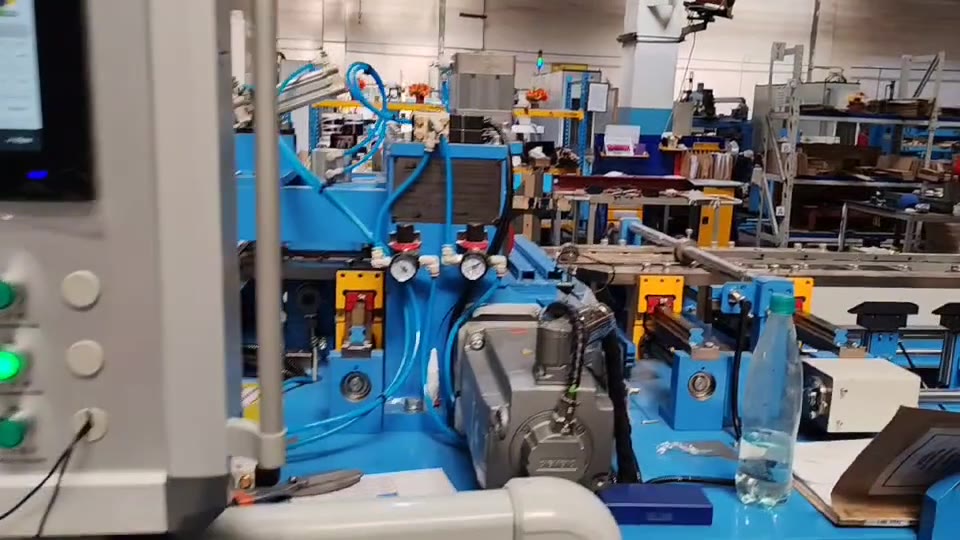
Within each width class SREE offers two versions of the cut-to-length line: the standard NC line, marked B in the model code, and the high-speed line, marked G. Both cut the same laminations to the same tolerances. The difference is how the strip moves through the machine, and that one difference changes the mechanics, the drives, the sorting end and the kind of production each line is good at.
Step feed versus continuous feed
On a standard line the strip moves in steps. The feed rollers advance it by one lamination length, the strip stops, the punches and the shear act, and the strip moves again. Every piece costs an acceleration, a stop and a cut cycle, so the average strip speed over a shift is well below the feed speed printed on the datasheet.
On a high-speed line the strip does not stop. The V-notch punch and the shear are mounted on carriages that accelerate to strip speed, make their cut while travelling with the strip, and return for the next piece. Because the strip runs continuously, output per hour is set by strip speed and piece length rather than by the number of stop-start cycles, which is where the gain in laminations per shift comes from.
What else changes
| Standard line (B) | High-speed line (G) | |
|---|---|---|
| Strip motion | Step feed; strip stops for every cut | Continuous; tooling travels with the strip |
| İstasyonlar | Fixed positions, adjusted mechanically for a new core geometry | All stations on servo axes, positioned by the program |
| Drives and control | NC control with servo feed | High-dynamic servo drives on feed and flying stations |
| Sorting end | Paired stacking tables (1+1, 3+3, 5+5) | Extended sorting chain to absorb the higher piece rate |
| Best suited to | Stable batches of a few core types | High tonnage and frequent changes of core type |
| Feed speed | Up to 210 m/min rated | 240 m/min peak, 210 m/min rated, 120–180 m/min recommended working speed |
Why changeover time matters as much as speed
The row that surprises most buyers is the last one. A high-speed line is usually bought for tonnage, but its second advantage is changeover. Because every station sits on a servo axis, moving from one core design to the next is a matter of loading the next program: notch positions, hole positions and lengths are set by the drives. On a standard line the stations are at fixed positions and a change in core geometry may need mechanical adjustment before the next batch can start. A plant that runs many core types in small batches therefore loses more time on a standard line than the speed figures suggest, and gains more from a high-speed line than the tonnage alone would justify.
The rule we use
This is the rule built into our online line selector. It is deliberately simple, and it works because most plants fall clearly on one side of it. Plants near the boundary should look at piece lengths and programme mix, which is what we do when preparing a proposal.
Speed figures, read carefully
High-speed lines quote three speeds, and they are not interchangeable. Peak speed, 240 m/min on our lines, is the highest strip speed the drives can reach and is useful only for long pieces. Rated speed, 210 m/min, is the design speed for continuous production. Recommended working speed, 120 to 180 m/min, is where the line runs day in, day out on typical lamination lengths, because shorter pieces leave less strip length for the carriages to accelerate and return. Output per shift should be estimated at working speed, never at peak. Peak speed vs real output gives a worked estimate.
Cost and floor space
A high-speed line costs more than a standard line of the same class: the flying stations, their servo axes and the drive electronics are the main items, and the extended sorting chain makes the line longer. In return it needs fewer operator interventions per shift and cuts more laminations per hour of running time. Which side of that trade you land on is almost entirely a function of tonnage and changeover frequency, which is why we ask for both before quoting.
What stays the same
Both versions share the same width classes, the same options for decoiler heads, V-notch and hole punch stations, the same control system choices and the same cutting tolerances: length ±0.2 mm per 2 m, angle ±0.02°, burr height 0.02 mm or less. A standard line is not a lower-quality line; it is a lower-output line.
Product details and specification tables for each class are on the standard cut-to-length line and high-speed cut-to-length line pages, and the satır karşılaştırması page puts the classes side by side.
Frequently asked questions
Can a standard line be upgraded to high-speed later?
Not in a practical sense. The continuous feed needs flying stations on their own servo axes and a different sorting end, which amounts to a different machine bed. Buy the version you will need in three years, not the one you need today.
Does a high-speed line cut thinner material?
Both versions cover 0.18 to 0.35 mm as standard, with 0.15 mm on request. Thin material affects feed and burr control on either line; see processing thin CRGO on a cut-to-length line.
Is a high-speed line harder to operate?
The operator’s job is the same: load strip, load the program, check the first pieces. The line does more automatically, which is the point.
Sizing a line for your core shop?
Send strip widths, thickness and monthly tonnage. You get a line proposal with knife layout and floor plan, or use the online selector to narrow the series first.